Wednesday, February 4, 2009

SAFETY AT SEA - The None Technical Write Up

Here's a very important issue for the post. SAFETY!

To start with, the best way to be run-off from the barge (Official term offshore for getting fired or transferred to another barge) is to break the safety rules on-board. Getting tired of working offshore? Wish to go home earlier then your scheduled time off? - Well, then try smoking next to the safety sign thats says "NO SMOKING". I am pretty sure you will get the 'first class ticket' home. In fact the company would even fire you JUST BEFORE your hit the ground because you were stupid enough to work on un-safe conditions at high places. Pretty straight forward. And like my boss would say, "...this I promise ya"

So whats all this fuss about safety this and safety that?

No doubt about it, the offshore or rather oil & gas industry spends a mother-load of money each year on safety at work and I can't blame them for giving me a scare when I first got here offshore. Hell, they even manage to scare the shit out of me when I was in the Basic Sea Survival course in MSTS (Miri). The videos and pictures of past disasters & accidents were good enough to put me on my toes, no need a second reminder. And glad I am that they did, hell, I know I am out here for the money, but I really don't want to go home in a body back or with one finger less. We keep it safe here, not just for ourselves but for each other. Its a buddy system we call it, you take care of yourself & me, and I will take care of myself and you.

Anyways, for those would be offshore workers. It is always a good thing to go through the Basic Sea Survival courses and attached the certificate with your resume when applying. This will be a bonus on to your application. Why? Well, basicly it shows that you have the fitness physically and mentally to work offshore and also it will save the employing company a lot of time and money to send your sorry arse to one. It does cost from RM2800 to RM3500 after all and on top of that the fee for a full medical check-up at authorised clinics. You should however, make sure it is OPITO approved and a full T-BOSIET plus boat transfer and underwater helicopter escape training. Did I say UNDERWATER helicopter escape? Yep..I did.

There is also a friend of mine who is planning to work offshore but he is aquaphorbic (scared of being under water) and thats not because he's cannot swim. It's because he's afraid of being underwater that made him cannot swim. Well, let me re-assure you and all you land lover dumb ducks out there, no matter how hopeless you are in staying a float while in water, ONLY, I say again, ONLY if your weight is 300 kilograms and above then you will probably sink to the bottom while wearing a work vest (see photo below). Most people will just stay a float without even trying to stay a float while wearing one.

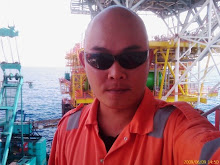
Such are our safety accesories offshore. Yes, that work vest don't seem much but if your weight is between 100 to 120 kilogrammes, it will keep you afloat...100 percent. Of course the basic PPE would be the coverall, safety helmet, safety shoes with steel toe and the safety glasses. Its your armour, use it. Its not cheap too, the orange coverall the gentleman is wearing above cost USD35.00...nett, no bargain, bargain.

Coveralls are usually worn while working on-board the barge - no mater its in the office or the deck itself. Well, its kinda cool to wear one because when can we ever wear one and look like a Slipnot band member or those people in hardcore-rap music videos...and actually look normal. Of course, it protects us from the everyday greese, dust and other uncomfortable dirt from our skins. And on an event of abandon ship where you have to float around waiting for rescue, the coverall will help you retain your body heat for about 1 and a half hour (tropical sea areas only) before your body starts to shiver with cold, followed by fatigue and probably die. Your body temperature only needs to drop by 1 degree celcius for this event to start. In the North Sea where the water temperature WILL be freezing cold, you won't be using coverall but a Survival Suit instead, with built in floating device, face cover, insulation and a vomit pipe. [see below picture - The Norwegian Sea Survival Suit] - it looks like a space suit and its hot to wear in tropical regions and only used in the extreme cold part of the sea world.

A Safety Helmet or most commonly called a 'hard hat', is another basic requirement to be worn while walking around the deck. It does protect the head from falling objects like bolts & nuts, small pieces of wood or anything to a certain degree. It won't however, protect us from a 200 ton load falling overhead. Usually when we see those kind of load hanging, we move away from underneath it. Pure logic and simple safety rule.

Lastly, offshore construction companies really do care about their workers offshore and they really spend a lot on safety at work places. Thats why, similar to some companies on land, they have safety officers. They do carry a burden to ensure safety policies are carried out adequately. Now its just up to them to make sure they do the job right. Muthafuckers...they get paid more then me too. Of course, we do have this thing call MANHOURS which calculates the amount of hours a barge worked over the years at sea at different project sites or oil fields. The more Manhour a barge collects, the better chance for it to bid for the next project. When an accident happens on board, usually its a big headache. I remember a 1 week investigation was carried out on-board just because some dumb duck stupid cunt decided to not wear safety gloves and cut-off one of his fingers. However, we got lucky. You see accidents as small as mentioned or worst still bigger ones, will make the barge loses its Manhours and will go down the record when bidding for the next project. A client will see this quite clearly as the clear sky and will question the ability of the barge to work safely, thus compromising a higher chance to win the bid. So yeah, the company do take care of us to work safely, but we have to take care of the company even more not to get hurt.

Tuesday, February 3, 2009

Terms & Conditions

After much thought, I think I better start this blog with some offshore terms. In other words, its how we talk at sea. Things are after all, very different around here. To be honest, all these terms did freak me out first time I am on-board a construction barge. As you can see on the picture on the right here. This one is called heavy lift barge.

Moving on, here are just a few of the terms I will be using throughout the blog (In lay-man's terms, for you dumb duck land lovers):

Port side & Starboard side [nautical term]

We can't really call the left side or the right side of a seafaring vessel as it is, cos it can really be confusing. After all, we have nothing around us except the sea. So some clever cunt invented these terms to stop all the confusion. Port side then (in general) became the side of the seafaring vessel that comes alongside the wharf or jetty when the vessel comes to port. The starboard side, of course will be the opposite.

Bow & Stern side [nautical term]

Another nautical term introduced most probably by the same clever cunt who made port side and starboard side. This time however, it means the front or the back of a seafaring vessel. Referring to the picture of the barge above, the stern would be where that big 2400 tonnes crane (orange in color) is sitting and the bow would be on the other end where our accommodation, bridge and helicopter landing deck sits.

Personal Protective Equipment

In short, PPE. Everyone must wear them regardless what you do on the barge. Like what this handsome gentleman on the picture here
is wearing. The orange clothing is called coveralls not jumpsuits. Jumpsuits are for the fools flying around in the sky and jumping out with parachutes. Of course, that white thing on his head is called a safety helmet. It will protect the head from small bolts & nuts but of course not from a 200 Ton load. We will discuss further about offshore safety in later issues on this blog. Then there's the safety shoes. Lastly, the safety glasses. It does not just make us look cool (like those actors in the Matrix) but also to protect our eyes from sharp objects and the sorts.


P.O.B.

In full, Personnel/Person on Board. Self explanatory actually but for some dumb ducks, it would be the amount of people working and staying on board the barge and not including the cats, dogs or birds that happen to come along with the ride. The POB for the barge I am working on can go up to a maximum of 226. That's a lot of people contributing their bodily waste into the sea.

Barges

I don't think I really need to go all technical on this topic since I have already posted a picture at the beginning of this post as an example (graphically). If you kinda missed it, kindly scroll up and have a good hard look. I will however tell you that there's different types of barge. As mentioned earlier on, we have a heavy lift barge and then there's a hook-up barge, a pipe-laying barge and a riser barge. More write ups will come about these different types of barges in upcoming issues on this blog.

Also, a barge is not a 'tongkang'. I got some dumb duck of a cunt friends thinking I am working on a 'tongkang'. Well, see it for yourself now and compare to that 'tongkang' you see used to transport sand or rubbish up and down the Satok Bridge River (Kuching). I have never been humiliated in my life!

Cunt

A typical swear word we use at sea. Varies in usage and meaning. There's blardy cunt, hopeless cunt, lame cunt, lazy cunt and of course my personnal favourite, stupid cunt. Its merely a word for expression actually, like an exclamation mark at the end of a sentence. LIKE THIS!!!! for example. It is also used quite normally during play or on serious conversations.

Mess Hall or Galley

This is what land lovers will be calling their dinning hall and kitchen area. We eat here and get fed with good food. Of course, when the food degrades, the cook will have to go and we will get a new one. Menus are divided between Asian food and western food. There are 4 meal times in a day starting from breakfast at 0500hrs and supper at 2200hrs. All the wholesome meals to keep up the energy on a hard days work at sea. Now, it may look like we are eating in some school canteen setup, but we do have the best food around like beef steaks, lamp chops, grilled salmon and most of the western food that will cost us quite a lot back in the land. I will be lying and bragging if I say our menu are exquisite cuisines but I will leave this picture showing what this gentleman have to eat for his dinner. You'll be the judge.

Well, I guess that would be enough for now. Thanks for reading this far though. Stay tune for the next post...more to come.


Home at Sea

Hear ye' land lubbers'

So I have decided to start my own blog. As much excitement I get from reading Mr. Ciaklat's blogs (http://www.ciaklat.blogspot.com/ & http://globalprecession.blogspot.com/) I hope to give much excitement to my fellow bloggers on my newly-started blog.

What am I going to write? Well, mostly to answer the million questions everytime I get when I get home for timeoff which usually pretty much about my offshore working experience. Other than that, I suppose I could vent my offshore frustration by writing . Of course this will be entirely my point of view and things can defer from one offshore worker to another.

I must warn all you fellow bloggers though, there WILL DEFINITELY be swear words on this blog so bear with me. Besides, ever heard people always say "Swear Like A Seaman"? I will however, TRY to minimise these vulgarities. But yeah, if you wanna know about offshore employment and how it feels to be working at sea..well...

Stay Tune & Happy Reading, cunts..

Nuff Said.